
12V battery voltage chart and parasitic drain test
Resting voltage vs state of charge
| Resting voltage | Approx. state of charge | What to do |
|---|---|---|
| 12.6 V or more | Full | Nothing. Voltage alone does not prove the battery is healthy, see below. |
| about 12.45 V | About 75% | Fine for daily use; charge it if the vehicle will sit unused for a long time. |
| about 12.29 V | About 50% | Charge it. Batteries left low for days can be permanently damaged. |
| about 12.2 V | About 40% | Charge now, then retest after resting. |
Values from AA1Car for a lead-acid battery at about 27 °C (80 °F) [2]. Different charts differ by 0.1–0.2 V, so treat them as a guide.
Measure correctly: right after driving or charging, a battery shows a "surface charge" that reads high. Let it rest for a few hours with the ignition off and the charger disconnected before you judge the reading.
Starting and charging voltage
- Engine running: about 13.5–14.5 V at the battery [2]. Clearly lower points to the alternator (or stator and regulator on a motorcycle); clearly above about 15 V points to the voltage regulator.
- While cranking: the voltage should not collapse. A very low reading during cranking means a weak battery or a bad connection. Formal load tests use a pass line of 9.6 V under a specific load and temperature [2], so a casual reading is only an indication.
- Motorcycles: charging voltage is often measured at around 2,000 rpm; follow your service manual, because specifications vary by model.
Old battery or parasitic drain?
If a new battery also goes flat after a few days, something is drawing current with the key off. Normal key-off draw comes from clocks, radio memory, alarms and control modules. The question is how much.
| Vehicle | Normal key-off draw | Likely problem |
|---|---|---|
| Car | Under about 50 mA after modules sleep [1]; some sources accept 20–80 mA depending on the car [7] | Over about 100 mA [1] |
| Motorcycle / scooter | About 1–5 mA as built [4] | Over about 30 mA can flatten the battery within a week [4] |
How to do a parasitic drain test
- Engine off, all lights and accessories off, doors closed (latch the door switches if you need access).
- Disconnect the battery negative cable and connect an ammeter in series between the negative post and the cable. Start on the meter's 10 A range [1].
- Wait for the modules to sleep: 10–45 minutes depending on the vehicle [1][3]. The reading falls as they shut down.
- Read the current. If it is above the normal range, pull one fuse at a time. When the reading drops clearly, that circuit is the suspect [1][3].
- Find what is on that circuit, fix it, refit everything and test again.
Safety. Do not start the engine or crank it while the meter is connected; the starter current will blow the meter fuse. Opening doors or switching on lights while connected can also overload the meter [5]. When finished, remove the meter before reconnecting the negative cable. If you are not comfortable with vehicle electrics, ask a technician.
Common causes of a drain
- Dash cams wired to permanent power, aftermarket audio, alarms, GPS trackers and USB sockets [3][4]
- Interior, glovebox or trunk lights staying on because of a stuck switch [3]
- Less often: a failed alternator diode or corroded battery terminals [7]
In hot climates, batteries also age faster. PhilKotse notes heat speeds up electrolyte loss and suggests many car batteries need replacing after about 3–4 years [6].
Tool for this job
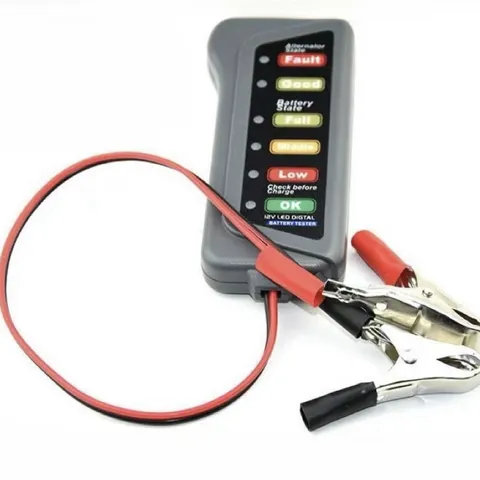
Clips onto the battery and shows charge level on LEDs, powered by the battery itself. Its card marks LOW at 11.5–11.9 V, MIDDLE at 12.0–12.5 V and FULL at 12.6–13.4 V, plus alternator status lights. It is a voltage indicator, not a load tester.
Buy on TikTok Shop- Fluke, How to find parasitic battery drain with a multimeter: fluke.com
- AA1Car, battery testing and voltage: aa1car.com
- Innova, How to test for a parasitic draw: innova.com
- Innovv, Why is my motorcycle battery dead after a few days: innovv.com
- The Drive, How to do a parasitic draw test: thedrive.com
- PhilKotse, Car battery draining overnight: philkotse.com
- Toolboom, Detecting leakage current in a vehicle: toolboom.com
General guidance only. Limits differ between vehicles; follow the manufacturer's specification.