
1156 vs 1157 and 7440 vs 7443: how to tell them apart
Short answer
1156 and 7440 are single-filament bulbs with one brightness. 1157 and 7443 are dual-filament bulbs with two brightness levels, usually tail light and brake light in one. They look almost the same, so check the base: a 1156 has one contact on the bottom and level pins; a 1157 has two contacts and pins at different heights [1]. A 7440 fits into a 7443 socket, but the light will not change between tail and brake brightness [2].
Comparison table
| Bulb | Close ECE equivalent | Base | Filaments | How to recognise it |
|---|---|---|---|---|
| 1156 | P21W | BA15s (metal bayonet) | 1 | One contact on the bottom; the two pins sit level, opposite each other (180°) |
| 1157 | P21/5W | BAY15d (metal bayonet) | 2 | Two contacts on the bottom; one pin higher than the other |
| 7440 | W21W, T20 single | W3x16d (glass wedge) | 1 | Wedge base with one pair of wire contacts |
| 7443 | W21/5W, T20 dual | W3x16q (glass wedge) | 2 | Wedge base with two pairs of wire contacts |
ECE equivalents share the base, but their wattage can differ slightly from the US numbered bulbs.
Which one does my vehicle use?
The quickest check needs no tools: look at the socket or the old bulb.
- Count the contacts. One contact on the bottom of a bayonet bulb means 1156; two means 1157. On a wedge bulb, count the wires folded around the base.
- Look at the pins. The offset pins let a 1157 go into its socket only one way [1], and they also stop it fitting a 1156 socket [4].
- Think about the job. A light that has one brightness (turn signal, reverse light) usually takes a single-filament bulb. A light that is dim as a tail light and bright when braking takes a dual-filament bulb. Some front turn signals double as parking lights and use a dual-filament amber bulb (1157 or 7443).
- Read the old bulb. The number is often printed on the metal base or the glass.
What happens if you fit the wrong one
- 7440 in a 7443 socket: it fits, because the wedge is the same size, but it only has one filament, so the light will not get brighter when you brake [2].
- 7443 in a 7440 socket: usually works on one level only. Results vary by vehicle, so use the correct bulb [2].
- 1156 in a 1157 socket: it can go in, but you lose either the tail light or the brake function, or the tail light becomes as bright as the brake light, which makes braking hard to see [4].
Switching to LED: three things to know
- Polarity. Many LED bulbs are polarity-sensitive. If a new LED wedge bulb does not light, pull it out, turn it 180° and push it back in [3].
- Fast flashing. LEDs draw much less current than filament bulbs, so some turn signal circuits flash fast (hyper-flash) or not at all. A load resistor or an LED-compatible flasher relay usually fixes it [3]. Load resistors get very hot: mount them on metal, away from wiring and plastic.
- Two levels. A dual-function LED must still show a clear difference between tail and brake. Check that the brake light gets visibly brighter after fitting.
Our bulbs
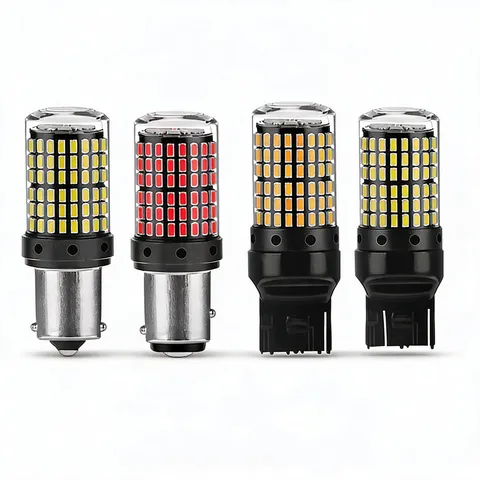
LED brake, turn and reverse bulbs, 12V
1156 (BA15s) in white or amber, 1157 (BAY15d) in red or amber, 7440 (T20 single) in white or amber, 7443 (T20 dual) in red. Sold as pairs of the same base and color.
Buy on TikTok ShopSources
- Bulb America, BA15s and BAY15d bases (pin layout and contacts).
- LASFIT, 7443 vs 7440 bulb differences (single vs dual filament, fitment in each other's sockets).
- Owner forum reports (Acurazine, Corvette Forum) on LED polarity and hyper-flash.
- Owner forum reports (e9coupe) on 1156/1157 fitment and using a 1156 as a tail light.
General guidance only. Check your owner's manual or the old bulb before buying.